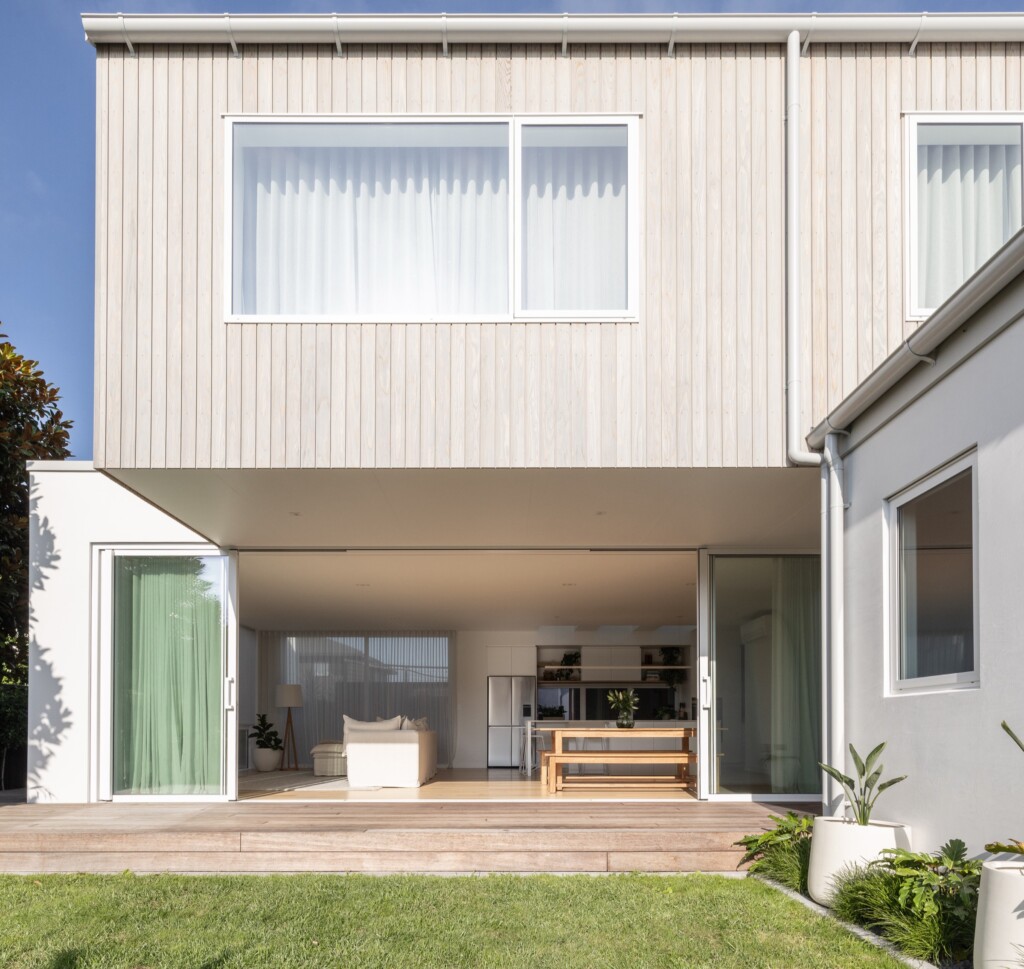
Clear or Traditional: the two grades of Sugi cedar
Sugi natural cedar products are now supplied in two grades: Clear and Traditional. Both are the same timber, imported Japanese Cedar heartwood milled in Tauranga, and both carry the same durability, the same profiles and the same finishes. The difference is what the grader lets through.
Clear
Clear is the select grade. Boards are chosen for straight grain and an even face, with knots and other natural features kept to a minimum. It is the grade for facades where the wall should read as a single calm surface, for large uncut runs, and for finishes where any feature would show through, such as the lighter Dryden oil colours or a Wabi Sabi charred finish where the brushed grain is the point.
Clear is the smaller share of any log, which is why it costs more. A tree produces a limited quantity of clear timber from its outer heartwood; everything closer to the centre carries the knots from the branches the tree grew in its early years.
Traditional is Japanese Cedar as it has always been used in Japan. The grade takes in sound knots, colour variation between the pink and the reddish-brown heartwood, and the natural figure of the tree. What it leaves out is anything that affects performance, such as loose knots, splits or decay.
The name is deliberate. In Japanese building, a sugi board with knots was never a second-rate board; it was most of the timber, and the houses, farmhouses and temple outbuildings of Japan are lined and clad with it. Clear selects were kept for the places that warranted them. Traditional returns to that way of using the tree: all of the usable heartwood goes into the product, not only the premium cut.
For a facade, that reads as a wall with more life in it, with the natural features and colour shifts giving the surface a rhythm a Clear wall doesn’t have. It suits bandsawn surfaces, the darker oil colours, and the Dento and Makkuro charred finishes, where the char evens the board out and the knots sit under it as texture.
Why two grades
Three reasons.
The whole tree gets used. Grading only for Clear means the larger part of each log goes elsewhere. Offering Traditional means the plantation timber we import is used to its full extent, which is what sustainable forestry is supposed to mean in practice.
Price. Traditional is priced below Clear because it is the larger share of the log and the grader passes more of it. For a project where the budget decides between cedar and something else, Traditional is the grade that keeps it cedar.
Choice. Some buildings want the calm of a Clear wall. Others want the timber to look like timber. Both are available in every profile and finish, and the two can be used on the same building: Clear on the street elevation, Traditional where the budget goes further.
What doesn’t change between grades
Species and origin: imported Japanese Cedar heartwood from managed plantation forest, GOHO certified. Durability: Scion natural durability class 2, the same classification as imported Western Red Cedar on the same test site; no chemical treatment. Moisture content: kiln dried to 12–16% at dispatch. Profiles: vertical shiplap, bevelback and horizontal shiplap, all under BEAL appraisal C2549 (see choosing a weatherboard profile). Finishes: dressed or bandsawn, Dryden exterior oils, or the Dento, Makkuro and Wabi Sabi yakisugi finishes, all shown on the Grades & Finishes page.
Specifying a grade
Write the grade with the profile: “Sugi vertical shiplap ST55, Traditional grade, Dryden Driftwood.” If you are unsure which grade a project wants, order samples of each in the finish you have in mind; the difference is clearer on a board than on a screen.
Choosing a weatherboard profile: vertical shiplap, bevelback or horizontal shiplap
Sugi makes three weatherboard profiles in Japanese Cedar, and the choice between them is mostly an architectural one. They share the same timber, the same finishes, the same cavity system and the same BEAL appraisal. Where they differ is the line they draw across a building, how they shed water, and how they are fixed.
The contemporary choice. Boards run vertically and interlock along their edges, so the wall reads as a flat plane broken by a regular negative detail. Five profiles give a choice of board width and shadow: the 140 mm ST51 and ST55 with a 6 mm negative are the standard; the wider ST56 and ST57 with a 3 mm negative give a finer line; the ST58 at 120 x 28 with a 10 mm negative gives the deepest shadow and the heaviest board.
Water runs straight down the face. Because the boards run vertically, they need horizontal battens or nogs behind them, which the cavity design allows for. Vertical shiplap is the profile most often specified in yakisugi, because the charred texture and the vertical line suit each other.
The traditional New Zealand weatherboard, and the one that sits most easily beside existing housing. Each board laps over the one below with the thick butt edge at the bottom, and the bevelled back beds against the cavity battens. The lap throws a stepped shadow that changes through the day.
Bevelback sheds water by the lap, the oldest and simplest detail there is. The board’s profile restrains the edge of the board below it, which is part of how it handles movement. Fixing is through the lap into the studs, pre-drilled and sized to the installation guide. Sugi’s ST61 is 140 x 20 mm.
Horizontal boards with a lowered shiplap rebate at the top, so water runs down the face without a step. The result is the flat plane of shiplap with a horizontal shadow line, often called a rusticated weatherboard. It reads as more contemporary than bevelback and calmer than a stepped lap, and it suits long low elevations where the horizontal line is the point. Sugi’s ST835 is 139 x 20 mm with a 6 mm negative.
Contemporary, flat, strong vertical rhythm: vertical shiplap. Pick the negative detail for the shadow you want.
Traditional character, or next to existing weatherboard housing: bevelback.
Horizontal line without the stepped lap: horizontal shiplap.
Charred finish: any profile, but vertical shiplap shows yakisugi best.
Mixing profiles: common, and the system is built for it. Vertical shiplap on an upper storey over bevelback below is a familiar New Zealand composition; the standardised dimensions let the two meet cleanly.
What doesn’t change
All three profiles are made from the same imported Japanese Cedar heartwood, Scion-tested at natural durability class 2 with no chemical treatment, kiln dried to 12–16% moisture content, and installed over a drained and ventilated cavity to E2/AS1 under BEAL appraisal C2549. Every profile has a DWG and PDF detail, and a specification and installation guide covering cover width, board size and fixing centres. Finishes are the same across the range: dressed or bandsawn surfaces, the Dryden exterior oil colours, or the three yakisugi finishes.
Charred timber cladding: what yakisugi is and how Sugi makes it
Charred timber cladding is the black, textured finish that has spread across New Zealand facades in the past decade. In Japan it is yakisugi, and the timber it has always been made from is sugi, Japanese Cedar. Sugi makes it the traditional way, on the traditional timber, to order at its Tauranga mill.
What charring does
Yakisugi is a centuries-old finishing technique and one of the earliest ways of thermally modifying timber. The face of the board is charred under controlled heat, which converts the surface to a layer of carbon. That layer does three things: it sheds water and UV, it removes the sugars and cellulose that fungi and insects feed on, and it gives the board a surface that weathers slowly rather than greying.
A charred board is then brushed to a chosen depth and sealed with a natural oil. The oil hardens the carbon layer and stops soot transfer, and the degree of brushing decides the look, from solid black to a grain pattern of carbon over coloured timber.
Charring suits Japanese Cedar in particular because the species has a pronounced difference between its soft earlywood and harder latewood. Brushing takes the char off the soft grain and leaves it on the hard grain, which is what gives yakisugi its three-dimensional surface.
The three Sugi finishes
Dento — charred and oiled. The full char layer is left intact and sealed with natural oil. This is the traditional finish: a deep matte black with the alligator-skin texture of the carbon. The thick layer of carbon gives the timber the longest life of the three, with re-oiling recommended every 10 to 20 years. Maintenance is optional; left alone, it weathers evenly.
Makkuro — charred, lightly brushed and oiled. The char is brushed back a little and the board is factory-coated with natural oil to hold the timber’s colour. The result is a smooth, lightly burnt surface that develops a patina with age. Re-oiling every 5 to 10 years keeps the original colour.
Wabi Sabi — charred, heavily brushed and oiled. The board is brushed twice, removing most of the char from the softwood and leaving carbon in the hard grain. The exposed timber takes a natural colour oil, followed by a factory sealing coat. Each board is hand-finished, and the finish is available in seven colours: Clear, Teak, Slate, Platinum, Dune, Driftwood and Moetapu.
Charring is a finish, not a substitute for a durable timber underneath. Sugi charred cladding is made from the same imported Japanese Cedar heartwood that Scion tested at natural durability class 2, the same classification as imported Western Red Cedar on the same test site, and the same timber covered by the BEAL appraisal for Sugi weatherboard. The char layer adds weathering and UV resistance on top of that.
Specifying it
Charred finishes are available on the Sugi weatherboard profiles: vertical shiplap (ST51, ST55, ST56, ST57, ST58), bevelback (ST61) and horizontal shiplap (ST835). Boards are charred and finished at the Tauranga mill, so every board in a run comes from the same process on the same timber.
Yakisugi is made to order. Allow around eight weeks for custom profiling and finishes, and order samples early, because the three finishes read very differently on a wall and the Wabi Sabi colours shift with the light.
Installation is the same as any Sugi weatherboard: over a drained and ventilated cavity to E2/AS1, pre-drilled fixings to the installation guide, and cut ends sealed on site. Charred boards should be handled with care before fixing; the carbon face marks if it is dragged.
Charred cedar, or charred something else
Most charred timber cladding sold in New Zealand is charred locally from whatever species is available. Yakisugi made from Japanese Cedar is the original pairing, and the reason the finish looks the way it does. If the brief says yakisugi, the timber underneath is worth asking about.
Every timber weatherboard moves with the seasons. The question a specifier should ask is not whether a cladding moves but how much, and whether the profile and the fixing are detailed to let it. For Sugi Japanese Cedar the answer is a fraction of a millimetre a season, and the detailing is already in the system.
How much a board moves
Timber swells as it takes on moisture and shrinks as it dries, mostly across the grain. The textbook figure for Japanese Cedar is about 5% tangential shrinkage, against about 4% for Western Red Cedar. Those numbers describe green timber dried to oven-dry, a range no cladding board ever travels on a wall.
What matters is the seasonal swing in service. New Zealand exterior timber settles at roughly 12–16% moisture content and moves within a few points of that through the year. Across a typical 12–18% swing, a 140 mm Sugi board changes width by about 1.4 mm. A 90 mm board moves under a millimetre. The 6 mm negative detail on a vertical shiplap absorbs that many times over.
Why the moisture content at dispatch matters
Sugi cladding is kiln dried to 12–16% before it leaves the Tauranga mill. That is already New Zealand’s exterior equilibrium, so the board goes on the wall close to its in-service moisture content and the large shrinkage has already happened in the kiln. Timber supplied wetter than that does its drying on the building, which is where gaps and cupping come from.
The real risk is cupping, not shrinkage
Sugi weatherboards are flat sawn, which puts the tangential face on the board face. Flat-sawn boards don’t just shrink across the width; they cup away from the heart side when the face and the back take up moisture at different rates. Four details manage it.
1. Board width. Narrower boards cup less and move less. The 140 mm profiles (ST51, ST55, ST61) are the usual choice; the 120 mm ST58 is narrower again. Profiles wider than 150 mm need closer fixing centres.
2. Coat all four faces. The single biggest cause of cupping is an uncoated back. Pre-coat every face, end and cut edge before fixing, as the installation guide specifies. Sugi can supply boards factory pre-coated with the Dryden two-coat exterior oil system, so only cut ends need touching on site. Uneven moisture uptake between face and back is what cups a board; the shrinkage coefficient is a distant second.
3. Let the profile do the restraining. The shiplap join on the vertical profiles (ST51, ST55, ST56, ST57, ST58) and the lap on the bevelback (ST61) hold the board edges by design, so the board cannot curl at the edge without the neighbouring board holding it. The negative detail, 3, 6 or 10 mm depending on profile, is the gap that movement runs into.
4. One fixing per board per stud. For boards up to about 150 mm, fix once per stud, pre-drilled and sized to the installation guide. The instinct with a timber that moves is to add fixings. Don’t. Two fixings across a board’s width restrain it, and a restrained board splits instead of moving.
The cavity
All Sugi exterior profiles are installed over a drained and ventilated cavity to E2/AS1, which is also what the BEAL appraisal (C2549) covers. The cavity keeps the back of the board dry and ventilated, which is as much a movement detail as a weathertightness one: it keeps the face and back of each board at a similar moisture content.
The short version
Sugi moves about a quarter of a millimetre more than Western Red Cedar across a 140 mm board over a season. It arrives at the moisture content it will live at. The cladding system’s profiles, negative details and fixing centres are set for that movement, and the one thing the installer controls, coating all four faces, is the one that matters most.
Western Red Cedar has been New Zealand’s default timber cladding for decades. It is now hard to get and expensive when you can. Japanese Cedar, or sugi, is the timber most specifiers reach for instead, so it is worth setting the two side by side on the things that matter for a wall: durability, movement, workability and supply.
Durability: the same class, tested in New Zealand
Durability is the question architects ask first, and it is the one with the clearest answer.
Scion, New Zealand’s forest research institute, ran ground-contact stake tests on imported Japanese Cedar heartwood at its Whakarewarewa test site. The stakes had an average life of more than eight years, which gives imported Japanese Cedar a natural durability classification of 2. Imported Western Red Cedar stakes tested at the same site returned a similar classification.
Two details from that testing are worth knowing. First, provenance matters: locally grown Japanese Cedar, like locally grown Western Red Cedar, rated a class lower at 3. Sugi cladding is imported heartwood from managed Japanese plantation forest, which is the material Scion tested at class 2. Second, Scion’s conclusion was that imported Japanese Cedar heartwood weatherboards should easily meet the 15-year minimum durability requirement of the New Zealand Building Code.
Sugi weatherboard is also covered by BEAL Appraisal C2549 for B1, B2, E2 and F2, with no chemical treatment required.
Oils, pre-coated Dryden system, yakisugi charred finish (made to order)
Oils
Supply
Plantation surplus; standard profiles in stock, custom profiles ~8 weeks
Constrained by quotas, wildfire seasons and tariffs
Movement: a quarter of a millimetre
Western Red Cedar is a little more stable than Japanese Cedar on paper: about 4% tangential shrinkage against 5%. Those are green-to-oven-dry figures, and no cladding board ever travels that range. What matters is the seasonal swing on the wall.
Sugi cladding is kiln dried to 12–16% moisture content, which is already close to New Zealand’s exterior equilibrium. Across a typical 12–18% seasonal swing, a 140 mm Japanese Cedar board moves about 1.4 mm and a Western Red Cedar board about 1.1 mm. The difference is roughly 0.3 mm, well inside what a standard negative detail absorbs. On a 90 mm board the whole movement is under a millimetre.
The practical point for both species is the same: coat all four faces, use shiplap or bevelback profiles that restrain the edges, and fix once per board per stud rather than over-fixing. Detailed that way, the two timbers behave alike in service.
Hardness and workability
Western Red Cedar is marginally harder (around 1,560 N Janka against 1,420 N), and both are soft, light timbers for their strength. Japanese Cedar is the easier of the two to work. It machines cleanly, takes a sawn face exceptionally well and does not tend to split or go fibrous on end grain the way cedar can. That makes a real difference to custom profiling, which Sugi does at its Tauranga mill.
Finish
Both timbers take oil finishes well. Where Japanese Cedar has the edge is range. It is the traditional timber for yakisugi, the Japanese charred-timber finish, which Sugi makes to order, and it can be supplied pre-coated with the Dryden two-coat oil system so only cut ends need touching on site.
Supply and sustainability
This is where the two part company. Western Red Cedar supply is constrained by harvest quotas, wildfire seasons and tariffs, and New Zealand is a long way down the queue. Japanese Cedar comes from renewable plantation forests with a structural surplus, through a GOHO-certified mill network that verifies the legal origin of every shipment. Sugi imports direct and holds weatherboard profiles in stock in Tauranga, with around eight weeks for custom profiling and finishes.
The short version
Imported Japanese Cedar sits in the same Scion durability class as imported Western Red Cedar, moves a fraction of a millimetre more over a season, is easier to work, takes a wider range of finishes, and is available. For most New Zealand cladding projects that were going to be cedar, it is the straightforward substitution.
Sugi is the Japanese name for Japanese Cedar, Cryptomeria japonica. It is Japan’s most planted and most used timber, the wood of its temples, shrines and houses for more than a thousand years, and the species behind yakisugi, the charred cladding that has become familiar on New Zealand facades. It is also our name, because it is the timber we built the company around.
The tree and the forests
Japanese Cedar is a tall, straight-growing conifer native to Japan. Despite the name it is not a true cedar; it is closer to the redwoods, which shows in the colour and the straight grain. Most of the sugi we import comes from managed plantation forests in Japan that have been replanted and harvested across generations, and much of it from the colder north, where slower growth gives a tighter grain and denser heartwood.
Japan has a surplus of plantation sugi, which is part of why supply is stable when Western Red Cedar is not. Our mill network is GOHO certified, which verifies the legal origin of every shipment. We import direct and process the timber at our mill in Tauranga for distribution throughout New Zealand.
What the timber is like
Freshly milled sugi is warm: pink, honey and reddish-brown heartwood, often within one board, with a pale sapwood band. The grain runs from straight and fine to bold, depending on the cut and the tree. No two boards match exactly, and that variation is the look architects specify it for.
It is a light timber, around 320–384 kg/m³ at 12% moisture content, which is close to Western Red Cedar. It is soft, machines cleanly, and takes a sawn or bandsawn face unusually well, which is why it profiles so readily and why the charred finishes work on it. There is a pronounced contrast between its soft earlywood and harder latewood; brushing a charred board takes the char off the soft grain and leaves it in the hard, and that is where yakisugi’s texture comes from.
Durability
Imported Japanese Cedar heartwood was tested by Scion at its Whakarewarewa site and rated natural durability class 2, the same classification as imported Western Red Cedar tested alongside it. Scion’s conclusion was that imported sugi heartwood weatherboards should easily meet the 15-year minimum durability the Building Code asks of cladding. No chemical treatment is required. Sugi weatherboard is covered by BEAL appraisal C2549.
Our cladding is kiln dried to 12–16% moisture content before dispatch, which is already New Zealand’s exterior equilibrium, so it goes on the wall close to the moisture content it will live at.
Where it is used
In New Zealand we supply sugi as exterior weatherboards (vertical shiplap, bevelback and horizontal shiplap), interior wall and ceiling linings, screens and battens, and for architectural joinery and features. Finishes run from a dressed or bandsawn surface, through the Dryden exterior oil colours, to the three yakisugi charred finishes. See the finishes.
Why we work with it
We have worked with a lot of species over thirty years. Sugi keeps its place because it does several things at once: it is durable enough for a New Zealand wall without treatment, light and easy to work, warm to look at, stable in supply, and plantation grown. We have spent years with the suppliers, in the forests and the sawmills, and the thing that stays with you is how long a view Japanese forestry takes. The trees being cut now were planted for this by people who would never see them milled.